Weighted GPA Guide: How AP, Honors, and IB Affect Your Score
GPA Calculation

Weighted GPA Guide: How AP, Honors, and IB Affect Your Score

January 27, 2026
9 min read
By Academic Success Team

Key Takeaways

What you need to knowQuick answer
Weighted GPA is not the same everywhereEach school sets its own rules and max scale
AP/IB usually add more than HonorsAP/IB often add +1.0, Honors often add +0.5
Credit hours change the final numberBigger classes can move your GPA more
Colleges read your transcript, not just one numberMany schools recalculate GPA their own way
Use both GPAs for smarter planningTrack weighted + unweighted side by side

What “Weighted GPA” really means (in plain English)

Weighted GPA gives extra points for harder classes. It answers one simple question: Should an A in AP Calculus count more than an A in regular Algebra? Many schools say yes.

Unweighted GPA stays on a fixed 0.0–4.0 scale. An A equals 4.0 no matter what class you take. Weighted GPA can go above 4.0 because it adds “bonus points” for course rigor.

That bonus can matter a lot. If your school gives AP/IB = 5.0 for an A, one tough class can boost your average. That is why two students with the same grades can have different GPAs.

If you want a clear side-by-side breakdown, use the weighted vs unweighted GPA guide and compare your numbers with a high school GPA calculator.

Weighted GPA rules explained chart for weighted vs unweighted GPA


Why schools weight AP, Honors, and IB classes

Schools use weighting to reward students who take harder courses. A student who chooses advanced classes takes on more reading, more tests, and more pressure. Weighted GPA helps show that effort.

Many students worry that one hard class could hurt them. Weighting is meant to reduce that fear. A B in a hard class might still look strong because the weighted points stay high.

But weighting also creates confusion. Students compare GPAs on social media, then panic. A “4.9 GPA” can mean many things. One school might cap at 4.5, another at 5.0, and another at 6.0.

To see why GPAs differ between districts, check how school districts calculate GPA and learn what scales exist in types of GPA scales. For fast planning, use the cumulative GPA calculator to test different course mixes.


Weighted GPA conversion charts: letter grades to points

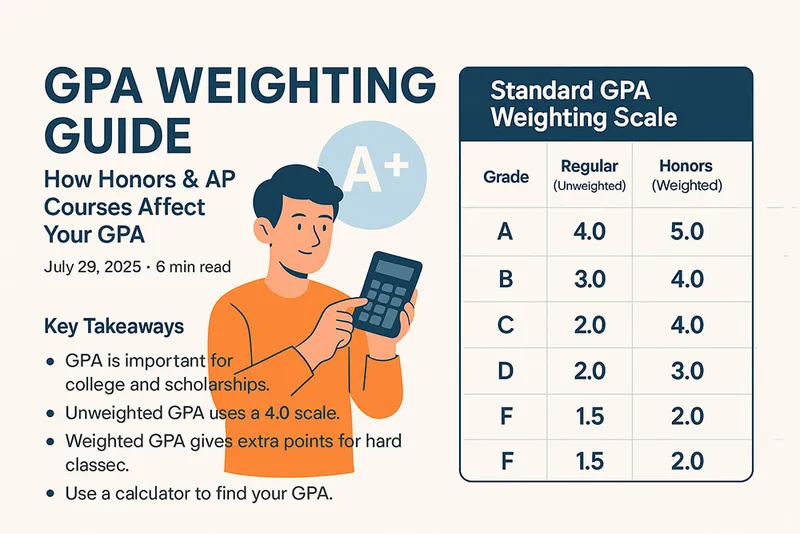
Most schools convert letter grades into points. Then they add bonus points for course level. That is why a single “A” can mean different things.

A common model looks like this:

  • Regular A = 4.0
  • Honors A = 4.5
  • AP/IB A = 5.0

Some schools use a different table or even a 100-point system. They might add +10 for Honors and +20 for AP. That can make the final GPA look “huge” even if the student is doing the same work as someone in a 5.0 system.

If you want a clean chart for your school, use letter-to-point GPA conversion and compare it with high school grading scales.

Weighted GPA rules explained with high school grading scales chart


The real math behind weighted GPA (quality points)

Weighted GPA uses quality points. Quality points combine your grade points and your credits.

A simple version works like this:

  • You earn a grade value (like 4.0, 4.5, or 5.0)
  • You multiply it by class credits
  • You add all quality points
  • You divide by total credits

This explains why one class can change your GPA more than another. A class with more credits has more “weight” in the math.

That is also why students see GPA surprises. They get straight A’s, but the GPA still drops. Credit hours and course level can cause that.

To understand what the numbers mean, read quality points vs GPA explained and see how credits change results in credit hour weighting.

Weighted GPA rules explained using quality points vs GPA example


AP weighted GPA rules: the most common system

AP classes usually get the biggest GPA boost. In many schools, AP adds +1.0 to your grade points.

That means:

  • AP A = 5.0
  • AP B = 4.0
  • AP C = 3.0

This is not a “free win.” AP work takes time. Many students spend extra hours each week on reading, practice tests, and review. That effort can pay off in two ways: a higher weighted GPA and possible college credit from the AP exam.

Still, the GPA boost only helps if you can keep solid grades. One AP class with a low grade can pull down both weighted and unweighted numbers.

If you want to see how AP weighting fits your school rules, use GPA weighting guide for Honors and AP and test your schedule with the high school GPA calculator.


Honors weighted GPA rules: smaller boost, big strategy value

Honors classes often add +0.5 instead of +1.0. A common setup is:

  • Honors A = 4.5
  • Honors B = 3.5

Honors can be a smart middle path. You get a GPA boost, but the workload is usually more manageable than AP or full IB programs.

Honors can also help you build skills before you jump into AP. Many students do better long-term when they step up in a steady way instead of taking too many hard classes at once.

One tricky point: some schools do not weight Honors at all. They call the class “Honors,” but the GPA points stay the same as regular.

If your GPA feels off, run a quick check with why GPA does not match transcript and review common mistakes in GPA calculation errors to avoid.

Weighted GPA rules explained when GPA does not match transcript


IB weighted GPA rules: HL vs SL can change the boost

IB classes often get the same weighted boost as AP. Many schools count IB as +1.0, especially for Higher Level (HL) courses.

IB is different from AP because IB works as a full system. It pushes students to write more, think deeper, and connect subjects. Some schools also separate weight by level:

  • IB SL might get a smaller boost
  • IB HL might get the full boost

This is why two IB students can have different weighted GPAs even with similar grades. Their school may weight HL more than SL.

IB can look very strong on a transcript, but it can also add stress. Your best plan is to match IB choices with your strengths. If writing is hard for you, take fewer HL courses. If science is your strength, lean into HL science.

For clean conversions, use IB to GPA conversion and compare outcomes with GPA scale comparisons.


Dual enrollment and weighted GPA: does college credit get extra points?

Dual enrollment can change weighted GPA rules a lot. Some schools treat dual enrollment like AP. Some treat it like Honors. Some give it the biggest boost.

That means the same class can count in different ways:

  • Dual enrollment = +0.5 at one school
  • Dual enrollment = +1.0 at another school
  • Dual enrollment = +2.0 in some advanced systems

This is why you must check your school policy before you assume the boost. Dual enrollment can also affect class rank, since it may raise your weighted GPA faster than AP.

If you take college classes and transfer them later, you should understand what gets counted. Some colleges accept credits but ignore the grades for GPA.

To plan safely, explore transfer credits GPA integrator and learn GPA rules for special cases like pass/fail grades.


Why your weighted GPA might differ from your friend’s

Weighted GPA is not standardized. Schools pick their own rules. That creates big differences.

Common systems include:

  • 5.0 max scale (most common)
  • 4.5 cap (limits inflation)
  • 6.0 scale (more levels of rigor)
  • 100-point weighted scale

A “4.3 weighted GPA” might be top of the class at one school and average at another. That sounds unfair, but colleges know this. They read your school profile and your transcript details.

This is also why social media GPAs can be misleading. People post a number with no context. The number alone does not show course rigor, grading policy, or class rank rules.

If you want to see how systems compare, review 5.0 GPA scale guide and learn the bigger picture in weighted GPA myths debunked.


How colleges really use weighted GPA in admissions

Most colleges do not rely on your school’s weighted GPA as the “truth.” They use it as a clue.

Admissions teams usually focus on:

  • Your unweighted GPA (how strong your grades are)
  • Your course rigor (how hard your classes are)
  • Your transcript pattern (did you improve or drop off?)

Many colleges even recalculate GPA using their own rules. This helps them compare students from many high schools. They can also use weighted GPA to understand class rank inside your school.

A high weighted GPA helps most when it matches a strong unweighted GPA. That combo shows you took hard classes and still earned strong grades.

If you want real context for different goals, check GPA requirements for college admissions and compare bigger targets like medical school GPA averages.

Weighted GPA rules explained for college admissions GPA requirements


Grade inflation and “GPA gaming”: why people argue about weighting

Some students chase weighted GPA for the number, not the learning. They load up on weighted classes, even if the subject does not fit their goals. That can lead to burnout.

Other students feel stuck because their school caps weighted GPA. They worry a lower max scale makes them look weaker. This stress spreads fast online, especially when students post GPAs with no explanation.

Grade inflation also makes it harder to compare students. More students earn A’s now than in the past at many schools. That pushes weighted GPAs higher too. A large group can end up above 4.0 weighted, even if test scores do not rise.

This does not mean your GPA is “fake.” It means your GPA needs context.

If you want a simple way to check if your GPA story looks clear, use transcript GPA audit guide and learn about trends in GPA inflation vs deflation.


Common weighted GPA mistakes that drop your number

Weighted GPA errors happen all the time. Many are simple.

Here are common problems:

  • You mark an Honors class as AP in a calculator
  • You forget a class with a different credit value
  • You mix semester credits and yearly credits
  • Your school does not weight Honors, but you assume it does
  • Your transcript shows percent grades, but you convert them wrong

Small input mistakes can move your GPA a lot, especially when you have many courses.

You can avoid most issues if you use the same method every time. Keep one file with your courses, credits, and levels. Then update it each term.

For clear rules, use how to calculate GPA and double-check the math with GPA formula guide. If your number still looks wrong, read common GPA calculation errors.

Weighted GPA rules explained with common GPA calculation errors guide


How to use a weighted GPA calculator the right way

A calculator works best when it matches your school’s rules. The easiest way is to track weighted and unweighted at the same time.

Start with these inputs:

  • Course name
  • Course level (Regular, Honors, AP, IB, Dual Enrollment)
  • Final grade (letter or percent)
  • Credits (0.5, 1.0, or another value)

Then compare outcomes. One extra AP class can raise weighted GPA fast, but it can also increase stress. A balanced plan often wins long-term.

If you want fast results, try the high school GPA calculator. If you want your full academic history, use the cumulative GPA calculator.

For better setup tips, use credits and course level input guide and the full high school GPA calculator guide.

Weighted GPA rules explained with high school GPA calculator guide


Frequently Asked Questions (FAQ)

What is a good weighted GPA in high school?

A “good” weighted GPA depends on your school scale. On a 5.0 scale, many students aim for 4.0+. On a 4.5 cap, a 4.0 can be very strong. Your course rigor matters as much as the number. Use the high school GPA calculator to see where you land.

Is weighted GPA more important than unweighted GPA?

Colleges care about both, but unweighted GPA shows your raw grades. Weighted GPA adds context for course rigor. Many schools compare students using transcript details, not just one number. This is why weighted vs unweighted GPA is a helpful check.

Do all schools give AP classes 5.0 for an A?

No. Many do, but some cap weighted GPA or use a 6.0 system. Some schools also weight dual enrollment differently. Always check district policy in how school districts calculate GPA.

Can weighted GPA go over 5.0?

Yes, if your school uses a 6.0 system or a 100-point weighted system. The number alone does not prove anything without the scale rules. Learn the differences in GPA conversion charts and tools.

Why does my GPA not match my transcript?

Schools may round differently, use hidden course rules, or treat credits in a special way. A missing course level tag can also break the math. Use why GPA does not match transcript to find the cause.

Should I take AP, Honors, or IB to boost my GPA?

Pick the hardest classes you can handle with steady grades. AP and IB often give the biggest boost, but they can also add stress. Honors can be a strong middle option. Compare choices in GPA weighting guide for Honors and AP and IB to GPA conversion.

What is the fastest way to raise weighted GPA?

Add rigor where you can succeed. One or two advanced classes with strong grades can help more than many hard classes with mixed grades. Use the cumulative GPA calculator and build a plan with raise my GPA action plan.

Do colleges recalculate weighted GPA?

Many do. They use their own system to compare students fairly across schools. Your transcript and school profile help them understand the context. If you want to aim for competitive programs, check GPA benchmarks for professional programs.