High School Grading Scales Chart: The Ultimate Guide to GPA Conversions
GPA Guide

High School Grading Scales Chart: The Ultimate Guide to GPA Conversions

January 20, 2026
8 min read
By Academic Success Team

Key Takeaways

What you’re trying to understandThe simple truthWhat to do next
Why grading scales feel inconsistentThe U.S. has no single national grading ruleAlways check your school’s own scale
The most common scaleMany schools use A = 90–100 (10-point scale)Use a percent-to-letter chart first
Why some GPAs look “lower”Plus/minus can turn an A- into 3.7Use a letter-to-points converter
Weighted vs unweightedAP/Honors can push GPA above 4.0Calculate both to compare fairly
Passing grades can change by districtSome schools treat D as passing, some don’tConfirm the minimum passing grade

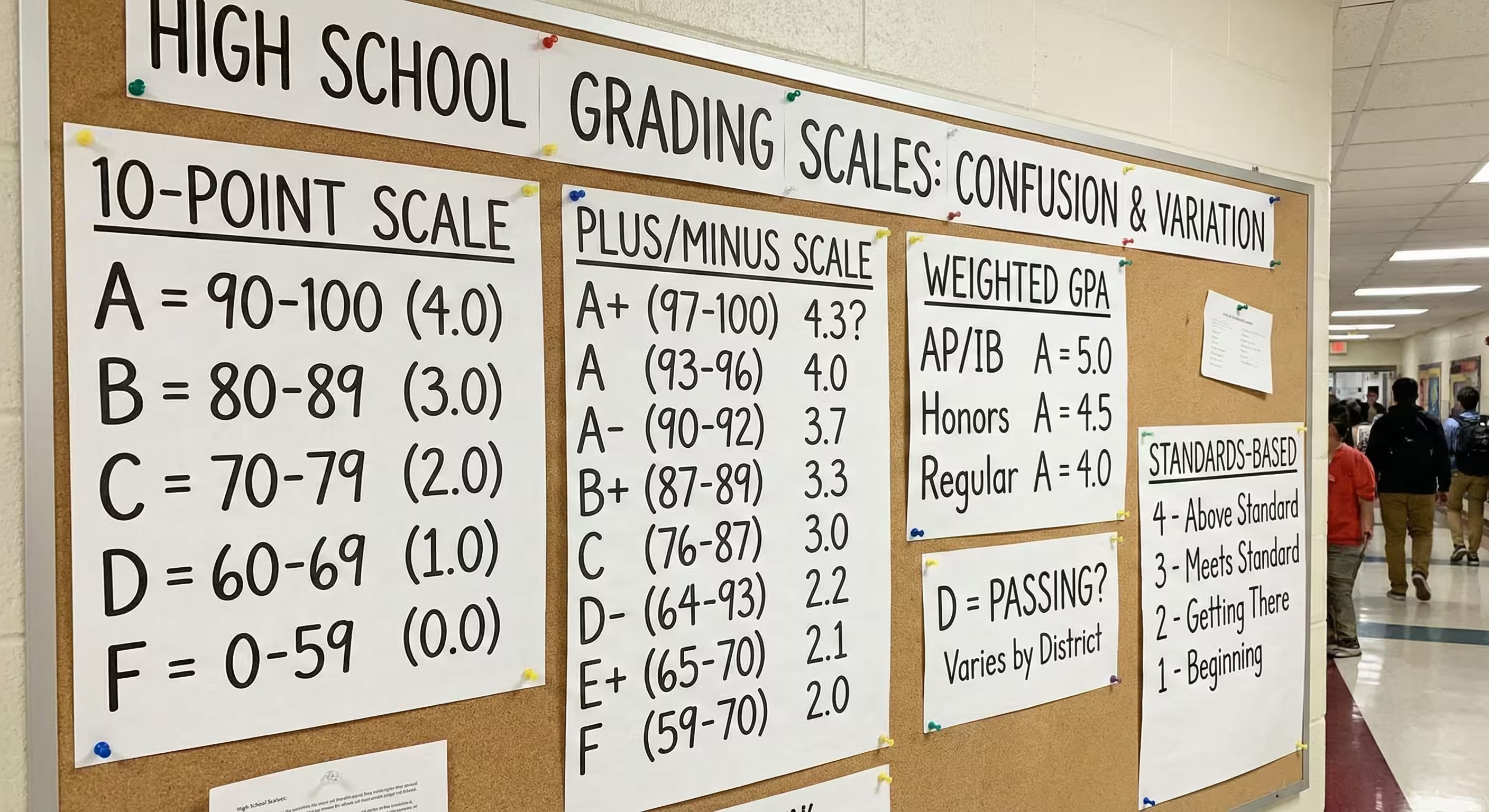
Common high school grading scales chart: why the same 90% can mean different things

A high school grade looks simple. You get a percent. You get a letter. You get a GPA. The problem is that schools do not all follow the same rules. One district may call 90% an A. Another may require 93% for an A. That can change your GPA even if your work stays the same.

This is why transfers feel stressful. A student can move states and watch the “same” grades turn into a new GPA. That feels unfair, but it happens often.

A grading scale chart helps because it shows the exact cutoffs. It answers questions like:

  • Is 92% an A or an A-?
  • Is 65% a D or an F?
  • Does the school give A+ points?

For more context on how schools set these rules, check types of GPA scales and how school districts calculate GPA.


The standard 10-point grading scale (A = 90–100) in plain English

The 10-point scale is the one most students expect. It splits 0–100 into big blocks. It feels easy because you can guess your letter grade fast.

Here is the classic version:

LetterPercentGPA points
A90–1004.0
B80–893.0
C70–792.0
D60–691.0
F0–590.0

This system has one big “buffer.” A 90% and a 99% both earn a 4.0. That can help students who start slow and improve later.

If you want to convert your grades fast, use how to calculate GPA and the letter-to-point GPA conversion guide.

Common high school grading scales chart for GPA calculation


Plus/minus grading: the 13-step scale that changes tiny gaps

Some schools add + and - signs to grades. This creates more steps and more GPA outcomes. A small percent change can move your GPA.

A common plus/minus layout looks like this:

  • A- (90–92) might be 3.7
  • A (93–96) might be 4.0
  • A+ (97–100) might be 4.0 or 4.3 (depends on the school)

Students like this system because it rewards small gains. A 89% (B+) feels different from an 80% (B-). The scale shows that difference.

Students also dislike it because it can “penalize” near-misses. A 92% feels like an A, but it may count like 3.7.

If your school uses plus/minus, the best helper tools are percentage to 4.0 GPA conversion and the 12-point to 4-point scale chart.

Percentage to 4.0 conversion chart for grading scales


The A+ problem: why a perfect score still may not raise GPA

A+ sounds like the best grade. In real schools, it can work three different ways:

  1. A+ counts as 4.0 (same as A)
  2. A+ counts as 4.3 or 4.33
  3. A+ is not used at all

This creates real confusion. A student with a 100% might earn the same GPA points as a student with a 93%. That feels odd, but it is a policy choice.

This is also why students compare transcripts and get different answers. Two students both say “I got all A’s,” but one school gives A- grades and another does not.

If you want to compare systems fairly, use GPA scale comparison and pros and cons of GPA scales. These pages help you see what your school rewards and what it ignores.

GPA scale comparison chart for common high school grading scales


Weighted GPA vs unweighted GPA: why some GPAs go above 4.0

Unweighted GPA treats every class the same. Weighted GPA adds bonus points for harder classes.

A simple version looks like this:

  • Regular A = 4.0
  • Honors A = 4.5
  • AP/IB A = 5.0

So two students can earn the same letter grade, but get different weighted points. An A in AP Biology can be worth more than an A in PE.

Many schools show both numbers on the transcript:

  • Unweighted GPA for clean comparison
  • Weighted GPA to show class difficulty

This is where people get confused. A 4.2 weighted GPA is not “better” than a 3.9 unweighted GPA in every case. It depends on course level.

Helpful tools include weighted vs unweighted GPA guide and GPA weighting for honors and AP.

Weighted vs unweighted GPA guide chart


The weighted GPA paradox: adding an A can lower your average

This sounds impossible, but it is real. Weighted GPA is an average of point values. If your average is very high, a regular A can be “below” your current average.

Example:

  • Six AP classes with A’s might average 5.0 points each
  • Your weighted average stays high
  • Then you add a regular class with an A = 4.0 points

The new 4.0 is still a great grade. It can still pull the average down because it is lower than 5.0.

This is why some students see a small dip after adding an elective. The fix is not “avoid extra classes.” The fix is to understand what the GPA is measuring.

To avoid mistakes, use credit hour weighting GPA guide and common GPA calculation errors to avoid. These help you track the real math behind your number.


Passing grades: D can mean “credit” or “retake,” depending on the school

A D is the most debated grade in America. Some schools treat it as passing. Others treat it as failing. Some allow credit but block the next class.

Common policies:

  • D = passing (you earn credit)
  • C = minimum passing (D means you must retake)
  • D passes, but it blocks prerequisites (you get credit, but you can’t move on)

This matters for sports, clubs, and graduation rules too. Many schools require a C average for eligibility, even if D still gives course credit.

If you want to plan your next move after a low grade, check how pass/fail grades impact your GPA and GPA planning for incomplete grades.

How pass fail affects GPA and course credit


Regional grading scale examples: California, Texas, New York, and New England

States and districts often follow local habits. Some regions set higher cutoffs for top grades. Others set higher cutoffs for passing grades.

Common examples:

  • Texas-style often uses A = 90–100, D = 60–69
  • New York-style often uses D = 65–69 and F below 65
  • Some California districts use higher “passing” cutoffs like F below 70
  • Many New England private schools raise the bar for A to 93+

These shifts change GPA fast. A student with many 90–92 grades can look stronger in a 10-point system than in a plus/minus system.

To compare two schools side by side, use 12-point vs 10-point GPA conversion and GPA conversion charts and tools.

12 point vs 10 point GPA conversion chart


Why colleges recalculate GPA and ignore parts of your transcript

Colleges need a fair way to compare students from thousands of schools. Since grading scales vary, many colleges recalculate GPA using their own rules.

Common recalculation choices:

  • Use only core classes (math, science, English, history)
  • Ignore some electives like PE
  • Convert grades into a standard format
  • Review difficulty by counting AP/Honors

This can make a student’s “official” high school GPA less important than expected. The school GPA still matters, but colleges may treat it as a starting point, not the final number.

If you want to check what your transcript really shows, use transcript GPA audit guide. If you are moving schools, use transfer credits GPA integrator.

Transcript GPA audit checklist for grading scale differences


Standards-based grading: levels instead of letters

Some schools now use standards-based grading (SBG). It does not focus on points and averages. It focuses on skill mastery.

A common SBG scale looks like this:

LevelMeaningRough letter match
4Above standardA
3Meets standardB
2Getting thereC
1BeginningD
0No evidenceF

SBG can feel clearer because it tells you what you can do. It can also feel confusing because conversion to GPA is not always clear. One district may map a “3” to 85%. Another may map it directly to 3.0 points.

Students in SBG schools should keep copies of rubrics and skill reports. These can help in transfers and applications.

For help calculating a traditional GPA from modern systems, use how to calculate high school GPA and the high school GPA calculator.

High school GPA calculator for common grading scales


International grading scales: IB, UK, Germany, and more

International students often face the hardest conversions. Many systems were not built to match the U.S. 4.0 GPA scale.

Common examples:

  • IB uses 1–7 per subject
  • UK often treats 70%+ as top-tier results
  • Germany uses an inverse scale where 1.0 is best
  • France often uses a 20-point scale

No universal conversion works for every school. Colleges often want the original grades and will do their own conversion.

For better clarity, use IB to GPA conversion guide and the international GPA converter guide.

International GPA converter guide for grading scales


Special cases: pass/fail, homeschool, and minimum failing grade policies

Some courses do not use normal letter grades. These special cases can change GPA rules fast.

Pass/Fail classes

  • A “Pass” may give credit but add no GPA points
  • A “Fail” may count as 0.0 and hurt GPA

Homeschool grading

  • Parents often set their own scale
  • Colleges usually want the scale written on the transcript

Minimum failing grade policies

  • Some schools set a floor like 50% for early quarters
  • This makes recovery easier on paper
  • It can also hide how far behind a student really is

The smartest move is to document your school policy. One screenshot or a handbook page can save weeks of confusion later.

For practical tracking, use high school GPA calculator template for Google Sheets and quality points vs GPA explained.

High school GPA calculator template in Google Sheets


Building a grading scales chart that works inside a GPA calculator

A strong grading scales chart makes GPA tools feel trustworthy. It should accept many input types and show clean results.

A helpful calculator setup includes:

  • Dropdown for your school scale
  • Input options for percent, letter, or points
  • Toggle for weighted vs unweighted
  • Transparent mapping like “92% = A- = 3.7”
  • Notes that colleges may recalculate

A good chart also helps students spot mistakes fast. If someone enters “A” but their school uses “93+ for A,” the tool can warn them before the GPA looks wrong.

If you want a full toolkit, use GPA conversion charts and tools and embed widget customization guide.

Embed widget customization for GPA calculator tools


Frequently Asked Questions

What is the most common high school grading scale in the U.S.?

Many schools use the 10-point scale where A = 90–100, B = 80–89, and so on. The cutoffs still vary by district, so it helps to check how school districts calculate GPA.

Is a 90% always an A?

No. Some schools require 93% for an A and treat 90–92% as an A-. A quick check with percentage to 4.0 GPA conversion helps you confirm the match.

Does A+ raise your GPA above 4.0?

Sometimes. Some schools give 4.3 for A+. Others cap it at 4.0 or do not use A+ at all. Comparing systems is easier with GPA scale comparison.

What is the difference between weighted and unweighted GPA?

Unweighted GPA uses a flat scale. Weighted GPA adds bonus points for AP/Honors. Use weighted vs unweighted GPA guide for a clear side-by-side view.

Can a D be a passing grade in high school?

Yes in many districts, but not all. Some schools treat D as credit. Others require a C to pass. Passing rules can also affect sports and prerequisites. If your class is pass/fail, check how pass/fail grades impact your GPA.

Why did my GPA drop after transferring schools?

Your grades may be the same, but the new school may use different cutoffs or plus/minus points. A transfer-friendly tool is transfer credits GPA integrator.

Do colleges use my high school GPA exactly as shown?

Often no. Many colleges recalculate GPA using their own rules. A smart way to double-check details is transcript GPA audit guide.

How should international students report grades to U.S. colleges?

Report grades in the original format and let colleges convert them. Conversion charts can still help you estimate outcomes with international GPA converter guide and IB to GPA conversion guide.