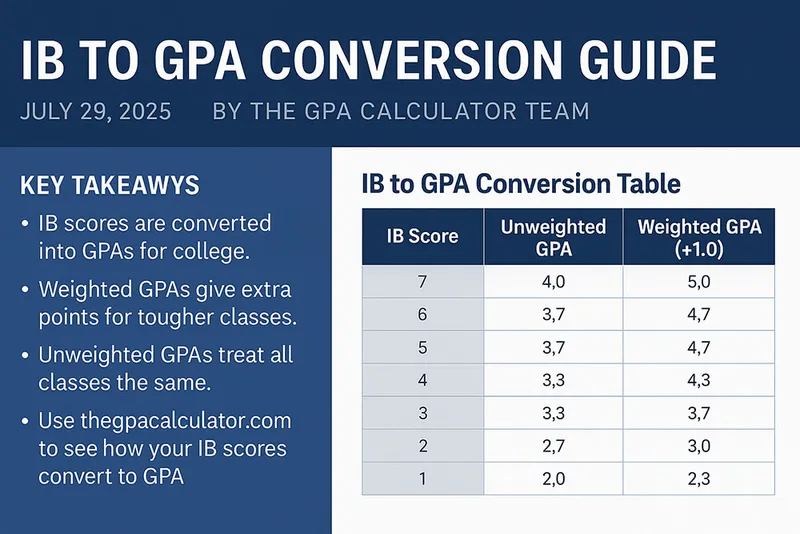
IB grades become a GPA through your school's own conversion table: the school turns each 1–7 IB result (or its own course grade for an IB class) into a letter grade and grade points, then averages them like any other course. The International Baccalaureate itself says it does not provide or endorse a conversion table to the U.S. A–F scale or the 4.0 GPA, so there is no official "IB 6 = 3.7" rule.
In practice, school charts generally count a 7 as an A, and the lower grades depend on the school. Below you will find how IB scoring works, how schools usually convert it, a worked example, and what to put on applications.
How IB scores work
The IB Diploma Programme (DP) scores each subject from 1 (lowest) to 7 (highest). A full diploma student takes six subjects, usually three at Higher Level (HL) and three at Standard Level (SL).
| Part of the diploma | Points available |
|---|---|
| Six subjects, 1–7 each | up to 42 |
| Theory of Knowledge + Extended Essay (combined) | up to 3 |
| Creativity, Activity, Service (CAS) | required, no points |
| Maximum diploma total | 45 |
HL and SL subjects use the same 1–7 grades and contribute the same number of points to the diploma total. HL covers more material, which is why many schools give HL classes extra weight in their own GPA — but that weighting comes from the school, not from the IB.
Why the IB does not publish a GPA table
The IB explains that U.S. grading scales are set locally, by states, districts and schools, and that many U.S. universities recalculate GPAs using their own criteria. Its recommendation is that schools submit IB results on the 1–7 scale, because that best represents student achievement.
So when you see a chart online that says "7 = 4.0, 6 = 3.7, 5 = 3.3," you are looking at one school's or one website's choice. Use your own school's chart if you need a number.
How schools usually convert IB grades
Most schools that offer IB do one of two things:
- They grade IB classes like any other class. Teachers give a percentage or letter grade during the year, and that goes on the transcript. The final IB score arrives later and may never enter the GPA.
- They map IB levels to letter grades. The school publishes a table such as the fictional one below.
| IB grade | Example school letter | Example points |
|---|---|---|
| 7 | A | 4.0 |
| 6 | A− | 3.7 |
| 5 | B | 3.0 |
| 4 | C | 2.0 |
| 3 | D | 1.0 |
| 1–2 | F | 0.0 |
This table is for illustration only. Your school's version may treat 6 as A, or 4 as C+, and that changes the result.
Worked example: unweighted and weighted
A fictional junior's predicted IB grades, each course one full-year credit:
| Subject | Level | IB grade | Points (example table) | With HL +1.0 |
|---|---|---|---|---|
| English A | HL | 6 | 3.7 | 4.7 |
| Biology | HL | 7 | 4.0 | 5.0 |
| History | HL | 6 | 3.7 | 4.7 |
| Mathematics | SL | 5 | 3.0 | 3.0 |
| Spanish B | SL | 6 | 3.7 | 3.7 |
| Economics | SL | 5 | 3.0 | 3.0 |
| Total | 35 | 21.1 | 24.1 |
Unweighted GPA = 21.1 ÷ 6 = 3.52
Weighted GPA (school adds +1.0 to HL) = 24.1 ÷ 6 = 4.02
The +1.0 bonus here is a school policy example, not an IB rule. Some schools weight both HL and SL, some weight only HL, and some add +0.5. You can test your own school's approach in the Weighted GPA Calculator, which applies a +1.0 bonus to AP/IB courses, or the High School GPA Calculator for all four years.
Why the proportional shortcut misleads. Dividing the subject total by its maximum gives 35 ÷ 42 × 4 = 3.33, and a diploma score of 37/45 would give 3.29. Both understate the student, because a 6 is a strong result that many school charts place in the A range. Diploma totals and GPAs measure different things, so keep them separate.
How colleges use IB results
Your high school GPA. U.S. colleges see the GPA on your school transcript, along with your IB courses and, often, your predicted or final IB scores.
Recalculated GPAs. Some colleges rebuild the GPA themselves. The University of California, for example, counts A = 4, B = 3, C = 2, D = 1 without pluses and minuses, and adds one honors point per semester for approved honors-level courses, including IB Higher Level courses for California residents, with a cap of 8 points across 10th and 11th grade (no more than 4 from 10th grade). For nonresidents, UC grants honors weight only for AP or IB courses.
International applicants. If your school only reports IB grades, UC tells international applicants to enter courses and grades "exactly as reported by the international school." In that case, enter your 1–7 grades rather than converting them.
For the broader question of which number to report, see should you report weighted or unweighted GPA and weighted vs. unweighted GPA.
Common mistakes
- Treating an online chart as official. The IB does not endorse any U.S. conversion.
- Adding HL weight your school doesn't use. Only report the weighting on your transcript.
- Mixing predicted and final grades. Label predicted grades clearly.
- Converting the diploma total into a GPA. A 38/45 is reported as 38/45.
- Forgetting non-IB courses. Your school GPA includes every graded class, not just your six IB subjects.
Frequently asked questions
What is an IB 6 on a 4.0 scale?
It depends on your school. Many school charts treat a 6 as an A− or A (3.7–4.0), but the IB itself does not set a value.
Is an IB 7 a 4.0?
School charts generally treat a 7 as an A, which is 4.0 unweighted. With a school's HL weighting it may count higher.
Do IB HL classes get an extra point?
Only if your school or the receiving college gives one. HL and SL count equally in IB diploma scoring.
What is a 38 IB score in GPA?
There is no conversion. Report the diploma total as 38/45 and your school GPA separately.
Do colleges prefer IB scores or GPA?
They look at both. Your transcript GPA shows your year-round performance, and your IB scores show results on external exams.