| Key Takeaways | What it means |
|---|---|
| GPA is an average of grade points, not just letter grades | You convert grades to points, then average them using credits |
| Credits matter | A 1.0-credit class counts more than a 0.5-credit class |
| Unweighted GPA caps at 4.0 | Every class uses the same 0–4 scale |
| Weighted GPA can go above 4.0 | Honors/AP/IB classes often get bonus points |
| Cumulative GPA uses all semesters together | You add total quality points and divide by total credits |
What GPA is and why it changes between schools
GPA means Grade Point Average. It turns your grades into one number. Schools use it to rank students, set honors, and decide who meets eligibility rules. Colleges use it to compare applicants, but they also look at your full transcript.
Most schools use a 4.0 scale for unweighted GPA. That means an A = 4.0 and an F = 0.0. Some schools also use a weighted GPA system. Weighted GPA gives extra points for harder classes like Honors, AP, or IB.
Two students can earn the same grades and still have different GPAs if they take different levels or credits. That is why it helps to learn your school’s exact method. If you want a clear breakdown of the math, the GPA formula guide explains the pieces in plain steps.
Gather the 4 things you need before you calculate
You need four details for every class you want to include:
- Course name (example: Algebra 2, AP Biology)
- Final letter grade (A, B+, C-, etc.)
- Credits (often 1.0 for full-year, 0.5 for one semester)
- Course level (Regular, Honors, AP, IB)
Your transcript is the best source because it shows the credits your school counts. Some schools give different credit values for labs, PE, or electives. If your list is wrong, your GPA will be wrong.
A simple table works great:
| Class | Grade | Credits | Level |
|---|---|---|---|
| English | B+ | 1.0 | Regular |
| Biology | A | 1.0 | AP |
| PE | A | 0.5 | Regular |
If you want to understand how credits change your final average, read the credit hour weighting GPA guide.
Convert letter grades into grade points
Once you have your grades, change them into points. Many schools use a plus/minus system like this:
| Letter grade | Points |
|---|---|
| A / A+ | 4.0 |
| A- | 3.7 |
| B+ | 3.3 |
| B | 3.0 |
| B- | 2.7 |
| C+ | 2.3 |
| C | 2.0 |
| C- | 1.7 |
| D | 1.0 |
| F | 0.0 |
Some schools do not use A- or B+. They may treat every A as 4.0 and every B as 3.0. That small change can move your GPA a lot, especially over 8 semesters.
If you only have percent grades (like 92%), convert them first using your school’s chart. Many schools use 90–100 as A, 80–89 as B, and so on. For a clean chart and quick conversions, the letter to point GPA conversion guide helps.
Calculate quality points for each class
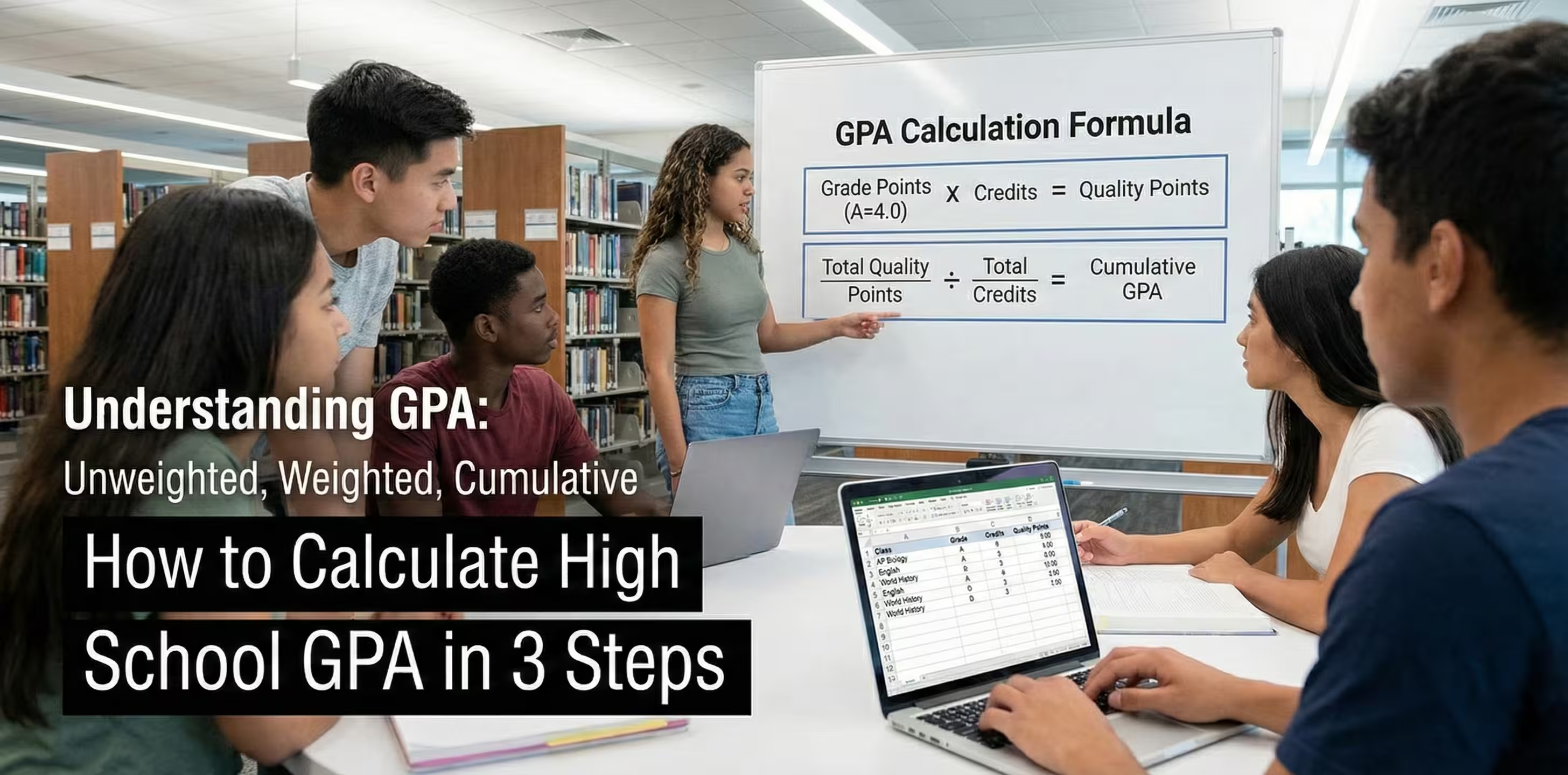
Quality points are the real building block of GPA. You calculate them like this:
Quality Points = Grade Points × Credits
Examples:
- AP Biology: A = 4.0 points, credits = 1.0 → 4.0 quality points
- PE: A = 4.0 points, credits = 0.5 → 2.0 quality points
- English: B+ = 3.3 points, credits = 1.0 → 3.3 quality points
This step fixes a common mistake. Many students add grade points and divide by classes. That fails when classes have different credit values.
Quality points also make cumulative GPA easy later. You just keep adding them over time.
If you want the idea explained with more examples and common traps, use quality points vs GPA explained.
How to calculate unweighted GPA with a full example
Unweighted GPA treats every class the same on a 4.0 scale. It does not add bonus points for class difficulty.
Example semester (4 classes, each 1.0 credit):
| Class | Grade | Points | Credits | Quality points |
|---|---|---|---|---|
| English | B+ | 3.3 | 1.0 | 3.3 |
| Algebra 2 | B | 3.0 | 1.0 | 3.0 |
| World History | A | 4.0 | 1.0 | 4.0 |
| Biology | A | 4.0 | 1.0 | 4.0 |
Total quality points = 14.3 Total credits = 4.0
Unweighted GPA = 14.3 ÷ 4.0 = 3.575 → 3.58
Some schools round to two decimals. Others keep three. Both are normal.
If you want to double-check your math fast, the high school GPA calculator page can do the same steps in seconds.
How to calculate weighted GPA for Honors, AP, and IB
Weighted GPA adds bonus points for harder classes. A common system looks like this:
- Regular A = 4.0
- Honors A = 4.5
- AP/IB A = 5.0
So the same letter grade can mean different points depending on the course level.
Example semester:
| Class | Level | Grade | Points | Credits | Quality points |
|---|---|---|---|---|---|
| AP Biology | AP | A | 5.0 | 1.0 | 5.0 |
| Algebra 2 | Honors | B | 3.5 | 1.0 | 3.5 |
| English | Regular | B+ | 3.3 | 1.0 | 3.3 |
| World History | Regular | A | 4.0 | 1.0 | 4.0 |
Total quality points = 15.8 Total credits = 4.0
Weighted GPA = 15.8 ÷ 4.0 = 3.95
For deeper rules (and why schools weight differently), use the GPA weighting guide for Honors and AP.
Why adding an easy A can lower a weighted GPA
This surprises a lot of students. Weighted GPA is an average. If your current average is high, a lower-point class can pull it down.
Example idea:
- You take six AP classes.
- You earn A’s in all of them.
- Many schools count each AP A as 5.0, so your average sits near 5.0.
Now you add one regular class with an A. Regular A may count as 4.0. That new class is still great, but it is lower than your current average. Your average drops slightly.
That does not mean you should avoid regular classes. You still need graduation credits. Colleges also like to see balance and strong grades.
If you want real examples that show how the average shifts, check weighted GPA myths debunked and weighted vs unweighted GPA for side-by-side cases.
Semester GPA vs cumulative GPA: the right way to average
Semester GPA uses only one term. Cumulative GPA uses every term you finished.
A common mistake is averaging GPAs like this:
❌ (3.4 + 3.8) ÷ 2 = 3.6
That only works when both semesters have the same credits and the same course load. The correct method always uses quality points:
✅ Cumulative GPA = (Total quality points) ÷ (Total credits)
Example:
- Fall: 13.6 quality points, 4.0 credits
- Spring: 15.2 quality points, 4.0 credits
Cumulative = (13.6 + 15.2) ÷ (4.0 + 4.0) Cumulative = 28.8 ÷ 8.0 = 3.6
If one semester has more credits, it counts more. That makes sense because you did more work.
For tools that do this automatically, use the cumulative GPA calculator and the semester GPA calculator pages.
Retakes, pass/fail, and electives can change your number
Schools treat special cases in different ways, so your GPA can shift based on policy.
Course retakes Some schools replace the old grade. Some average both grades. Some count both. If you retake a class, read your handbook or ask a counselor.
Pass/fail classes Some schools exclude pass/fail from GPA. Others count Pass as a set value. If your school excludes them, your credits still count, but your GPA stays the same.
Core vs elective classes Colleges often recalculate GPA using core subjects only (math, science, English, social studies, language). That means your “school GPA” can look higher than your “college core GPA.”
If you want tools for these cases, use the repeat course GPA recalculator and how pass/fail grades impact your GPA.
How to handle percent grades and other GPA scales
Some schools show grades as percentages. Others use different scales like 5.0, 10-point, or 12-point systems. The safest move is to convert your grades using a chart that matches your school.
Common percent rule (varies by school):
- 90–100 = A
- 80–89 = B
- 70–79 = C
- 60–69 = D
- Below 60 = F
Then you convert letters into points and calculate quality points like normal.
If your school uses a 5.0 system, do not force it into 4.0 without checking the rule. Some schools already build honors weight into the scale.
Helpful tools:
Grade inflation and how colleges actually read GPA
Grades have risen over time at many schools. That makes raw GPA less useful for comparing students across districts. A 3.9 at one school can mean something different at another school.
Because of that, many colleges recalculate GPA using their own rules. They may:
- Convert everything to an unweighted 4.0 scale
- Use core classes only
- Look at course rigor separate from the number
Admissions teams also scan patterns. They care about strong grades in harder classes and steady progress from year to year. If your freshman year was rough, later semesters can still show growth, but your cumulative average keeps early grades in the mix.
If you want a clear view of trends, read GPA inflation vs deflation and how school districts calculate GPA.
Simple ways to track GPA all year without stress
GPA gets easier when you track it early. Small changes matter more than people think, especially in a year with many credits.
Good habits:
- Update your grades every time a report card posts
- Watch classes with big credits (lab sciences, math, language)
- Check how one bad test can change a final letter grade
- Aim for steady B+ and A- grades instead of chasing perfect
If your grades drop mid-term, it helps to set a target and build a plan. Use tools like the mid-term grade projection slider and the study tips for better grades guide to stay in control.
Helpful pages:
For the fastest option, use the calculator on The GPA Calculator homepage and save your results as you go. Free GPA calculator tool or visit The GPA Calculator
Frequently Asked Questions
How to calculate high school GPA in 3 steps?
List your classes, grades, and credits. Convert grades into points using your school’s chart. Multiply points by credits, add quality points, then divide by total credits. The how to calculate GPA page shows the same math with clean examples. How to calculate GPA
What is the difference between weighted and unweighted GPA?
Unweighted GPA treats every class the same and caps at 4.0. Weighted GPA adds bonus points for Honors, AP, or IB classes, so it can go above 4.0. This guide explains both side-by-side: Weighted vs unweighted GPA guide
Can a regular class lower my weighted GPA even with an A?
Yes. If your current weighted average is higher than 4.0, a regular A (4.0) can pull your average down slightly. The effect is small, but it is real. Weighted GPA myths debunked
Do colleges use my exact high school GPA?
Many colleges recalculate GPA using their own rules. They may focus on core classes only and convert your grades to an unweighted scale. This helps them compare students fairly. Core vs elective GPA
How do I calculate GPA if my school uses percent grades?
Convert each percent into a letter grade using your school’s cutoffs, then use the point scale to calculate quality points. This conversion tool helps: Percentage to 4.0 GPA conversion
How do retakes affect GPA?
It depends on your school. Some replace the old grade. Some average both. Some count both grades. Use this tool when your transcript includes repeats: Repeat course GPA recalculator
What is the easiest way to avoid GPA math mistakes?
Always calculate with quality points and credits. Do not average semester GPAs. This checklist covers the common errors students make: Common GPA calculation errors to avoid


