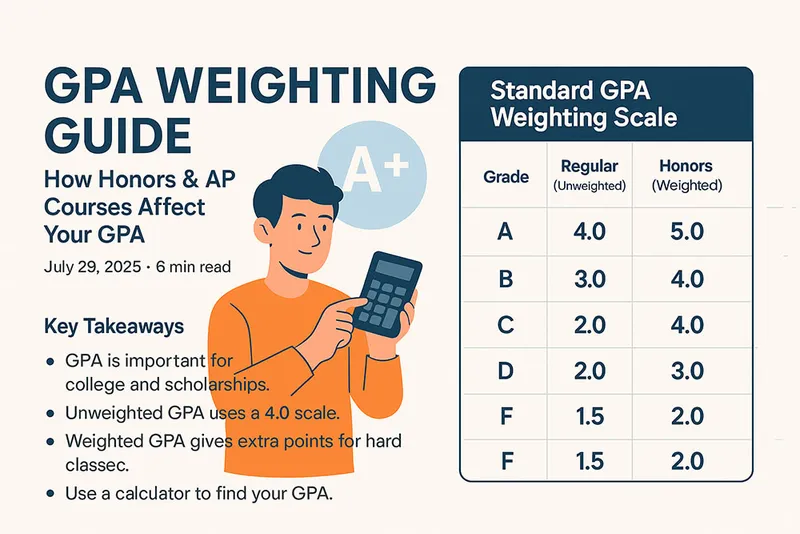
To calculate a weighted GPA, give each class its normal grade points (A = 4, B = 3, C = 2, D = 1, F = 0), add a bonus for designated advanced classes (most commonly +0.5 for Honors and +1.0 for AP, IB or dual enrollment), then average the results by credits. For example, an A in AP Biology (5.0), a B in Honors English (3.5) and an A in regular Geometry (4.0) average to (5.0 + 3.5 + 4.0) ÷ 3 = 4.17.
That is the whole method. The rest of this guide shows how to handle credits, how real schools set up their scales differently, and the myths that trip people up.
Step-by-step: calculate a weighted GPA
Your school's handbook or school profile has the final word on bonus amounts and which classes qualify. If you can't find it, the +0.5 / +1.0 scheme below is the most common starting point.
- List every class that counts toward your GPA, with its final grade and credits.
- Convert each grade to base points. On a plain 4.0 scale: A = 4, B = 3, C = 2, D = 1, F = 0. If your school uses plus and minus grades, use its table (for example A− = 3.7, B+ = 3.3).
- Add the bonus for each eligible class: +0.5 for Honors, +1.0 for AP, IB or dual enrollment.
- Multiply each class's weighted points by its credits. These are the class's weighted quality points.
- Add up all weighted quality points and divide by total credits.
Worked example with different credits
Sam, a fictional sophomore, has this semester:
| Class | Level | Grade | Credits | Base points | Bonus | Weighted points | Weighted points × credits |
|---|---|---|---|---|---|---|---|
| AP World History | AP | B+ | 1.0 | 3.3 | +1.0 | 4.3 | 4.30 |
| Honors Chemistry (with lab) | Honors | A− | 1.5 | 3.7 | +0.5 | 4.2 | 6.30 |
| English 10 | Regular | A | 1.0 | 4.0 | 0 | 4.0 | 4.00 |
| Algebra II | Regular | B | 1.0 | 3.0 | 0 | 3.0 | 3.00 |
| Health | Regular | A | 0.5 | 4.0 | 0 | 4.0 | 2.00 |
Total weighted quality points: 4.30 + 6.30 + 4.00 + 3.00 + 2.00 = 19.60
Total credits: 1.0 + 1.5 + 1.0 + 1.0 + 0.5 = 5.0
Weighted GPA: 19.60 ÷ 5.0 = 3.92
For comparison, Sam's unweighted GPA (same steps, no bonuses) is (3.3 + 5.55 + 4.0 + 3.0 + 2.0) ÷ 5.0 = 17.85 ÷ 5.0 = 3.57. The 0.35 gap is the bonus points (1.0 × 1 credit + 0.5 × 1.5 credits = 1.75) divided by 5 credits.
For more on the side-by-side view, see weighted vs. unweighted GPA.
Two ways schools build weighted scales
Most schools use one of two designs. They give similar results but look different on paper.
Design 1: add a bonus to a 4.0 base
This is the "+0.5 / +1.0" approach. Fairfax County Public Schools in Virginia is a clear published example. Its base table runs from A = 4.0 down through A− = 3.7, B+ = 3.3, B = 3.0 and so on, and then:
| FCPS course type | Bonus added |
|---|---|
| Honors | +0.5 |
| AP | +1.0 |
| Advanced | +1.0 |
| Dual Enrollment | +1.0 |
| IB | +1.0 |
Under this design, the top weighted value is 5.0 (an A in an AP class), and schools usually describe it as "a 4.0 scale with weighting" or "a 5.0 weighted scale."
Design 2: a separate scale for each course level
Some schools assign each course level its own maximum instead of adding a bonus. Texas districts often work this way.
- Princeton High School (Princeton ISD, Texas) lists its GPA scale as Regular 5.0, Honors 5.5, Dual Credit 6.0 and AP 6.0 in its school profile, and it ranks students by the weighted GPA.
- Cypress-Fairbanks ISD (Texas) calls its system a "weighted 6.0 grading scale," but its published table gives an A in an advanced-level (K, AP or HORIZONS) course 7 grade points and an A in an on-level course 6 points. A B is worth 6 and 5 respectively, and so on down the table.
Notice that in both Texas examples the gap between levels is still a fixed step (0.5 or 1.0), just like Design 1. What changes is the starting number. That is why a "6.0 GPA" and a "5.0 GPA" from different schools can describe very similar grades. The 4.0 vs. 5.0 vs. 6.0 GPA scales guide compares these labels in detail.
How colleges handle weighting
Many colleges take your transcript and apply their own rules, so your school's weighted number is not always the one they use.
- University of Florida recalculates a core weighted GPA on a 4.0 base: AP, IB, AICE and core dual enrollment courses get an extra 1.0 (an A counts as 5.0), and Honors, pre-AP, pre-IB and pre-AICE courses get an extra 0.5 (an A counts as 4.5).
- University of California counts A–G courses from the summer after 9th grade through the summer after 11th, ignores plus and minus, and adds one point per semester of approved honors coursework for grades of C or better, up to 8 points total and no more than 4 from 10th grade. UC says not to round the result.
If you are applying to a college that publishes its own method, it can be worth running that calculation too, so you know where you stand.
Weighted GPA myths
Myth: Honors is always +0.5 and AP is always +1.0. Those are common values, and FCPS and UF both use them, but schools set their own. Cypress-Fairbanks uses a full point between its advanced and on-level tables and has no separate half-point Honors tier in the table above.
Myth: Any class called "AP" earns the AP bonus. The College Board's AP Course Audit is what authorizes a school to put the "AP" label on a transcript. Your school then decides how much weight that label carries. A local "advanced" or "accelerated" class only gets a bonus if your school's policy lists it.
Myth: A weighted GPA can be converted to unweighted by dividing. Dividing a 4.6 by 5 and multiplying by 4 gives 3.68, but that number is meaningless. To get your unweighted GPA, recalculate from the original letter grades with the bonuses removed.
Myth: You can turn a percentage into a 5.0 GPA by multiplying by 0.05. A 90 average times 0.05 gives 4.5, but no common weighted scale works that way. Weighted points come from letter grades plus course-level bonuses, not from a straight percentage.
Myth: A bonus applies to every grade. Many policies give no extra point for a D or F. UC's honors point, for example, does not apply to D or F grades.
Myth: A higher weighted GPA always looks better to colleges. Admissions readers see both your grades and your course choices on the transcript. A weighted number is one summary of that, not a replacement for it.
Common calculation mistakes
- Forgetting to multiply by credits when classes have different credit values.
- Including classes your school excludes (some leave out PE, local courses or credit recovery; Princeton High School excludes local courses, credits by exam and credit recovery from GPA).
- Adding the bonus twice, once to the grade and again to the total.
- Mixing your school's plus/minus table with a college's whole-letter table.
Calculate it quickly
The Weighted GPA Calculator applies Honors (+0.5) and AP/IB/college-level (+1.0) bonuses for you, and the High School GPA Calculator shows weighted and unweighted results across all four years. If your school uses a different scale (such as Design 2 above), use the manual steps in this guide; the arithmetic is the same once you know each class's points.
Frequently asked questions
What is the highest possible weighted GPA?
It depends on the scale. On a +0.5/+1.0 system built on 4.0, the top value is 5.0 (all As in AP or IB classes). On scales like Princeton's or Cypress-Fairbanks', the maximum is higher because the base numbers are higher.
Do dual enrollment classes get weighted?
Often, yes. FCPS adds 1.0 for Dual Enrollment, Princeton places Dual Credit on its 6.0 tier, and UF adds 1.0 for core dual enrollment courses. Check your school's list.
Is a B in an AP class better than an A in a regular class?
On a +1.0 system they are worth the same weighted points (3.0 + 1.0 = 4.0). On the unweighted scale, the A is higher. Choosing classes is about your interests, readiness and goals as much as the math.
Should I calculate weighted GPA by semester or by year?
Use whatever your school uses, which is usually semester grades. Princeton High School, for example, ranks students on semester grades earned for high school credit.