
| Key takeaway | What the unweighted GPA example shows | Fast action |
|---|---|---|
| Unweighted GPA is plain math | Schools convert each grade to points (often A=4, B=3, C=2, D=1, F=0) and average them. | Check the grade-to-point rules before you calculate. |
| One B moves the number more than most people expect | In common schedules, a single B can drop a perfect term into the 3.7–3.8 range. | Use a what-if check in a high school GPA calculator: high school GPA calculator. |
| Freshman year can “stick” | A weak first year can keep your cumulative GPA lower even after strong later years. | Track the full history with a cumulative GPA calculator. |
| Plus/minus and credits can change everything | A− vs A and 0.5 vs 1.0 credits can shift your result over time. | Confirm your school’s scale and credit weights first. |
Unweighted GPA examples and the 4.0 math
Unweighted GPA examples (common schedules) all follow one rule: quality points ÷ total credits = GPA. Most schools use a 0.0–4.0 scale, then average your courses. Some schools add plus/minus points (like A− = 3.7) and some do not. Some schools count every course. Others count only “core” classes like math, English, science, and history.

A quick way to stay accurate is to learn the terms. “Quality points” means the grade points you earn per class. “Credits” means how much each class counts. Clear definitions help you avoid common mistakes like counting a pass/fail class as an A. Use these guides if the terms feel unclear: GPA formula explained and quality points vs GPA.
Common schedule example: all A’s in 5 classes (4.0)
This is the cleanest unweighted GPA example. A student takes five equal-credit classes and earns all A’s. Each A is 4.0 points.
| Course count | Grade pattern | Total points | GPA |
|---|---|---|---|
| 5 | A, A, A, A, A | 4+4+4+4+4 = 20 | 20 ÷ 5 = 4.0 |

Many students assume a 4.0 is “easy” if they work hard. The math is easy. The consistency is hard. One missing assignment can turn an A into a B, and the average drops fast in small schedules. If you want to test real outcomes, enter your exact class list in the high school GPA calculator and compare it with your school’s rules in how to calculate high school GPA.
Common schedule example: 5 A’s and 1 B (3.83)
This pattern shows up in real transcripts because it is “mostly A’s” with one tough class. A student takes 6 equal-credit classes and earns 5 A’s and 1 B.
| Grades | Points | Total | GPA |
|---|---|---|---|
| 5 A’s | 5 × 4.0 | 20.0 | |
| 1 B | 1 × 3.0 | 3.0 | |
| Total | 23.0 | 23 ÷ 6 = 3.83 |

A 3.83 can be strong for many students, but it is not “almost 4.0” in the way it feels. The B keeps showing up each term if the same class stays hard. If you want to see how one B per term changes your long-term average, track it in a cumulative GPA calculator. If that B comes from weak study habits, start small with study tips for better grades.
Common schedule example: one B in 7 classes (3.86)
In larger schedules, one B hurts less because more A’s “spread out” the drop. Here is a simple unweighted GPA example: 7 classes, 6 A’s, 1 B.
- Total points = (6 × 4.0) + (1 × 3.0)
- Total points = 24.0 + 3.0 = 27.0
- GPA = 27.0 ÷ 7 = 3.86
That looks close to the 3.83 example, even though the student has the same single B. Class count matters. So does your school’s letter conversion rules. Some schools use plus/minus. Some round.
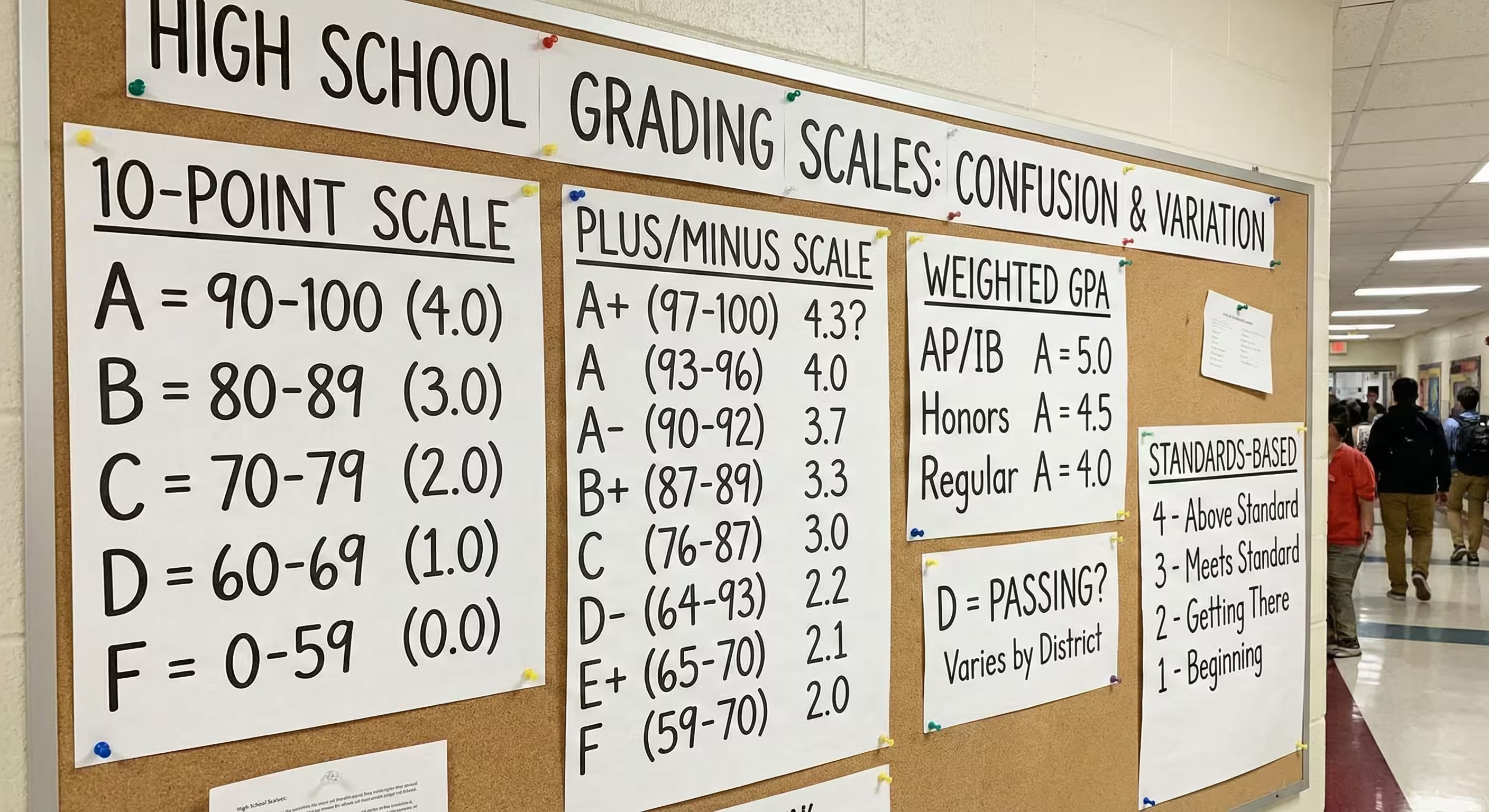
To match your school, confirm the mapping in letter-to-point GPA conversion and run the same grades in a semester GPA calculator.
Common schedule example: freshman slump and later recovery (why the dip stays)
A common question is “Can a strong comeback erase a weak freshman year?” The answer is: the trend helps, but the average still counts the early grades. If a student posts a low freshman GPA, then earns strong grades later, the cumulative rises slowly because the early credits stay in the math.

A clear way to see it is to track year by year. A student who starts near 2.9 and later earns several 4.0 terms can still land near the mid 3’s overall. That is not a failure. It is the result of averaging. Colleges often like the upward pattern, but they still see the full record. To plan a realistic target, use a freshman year GPA predictor, then map your next terms in a raise my GPA action plan and visualize progress with a GPA trend graph generator.
Common schedule example: honors/AP heavy load (unweighted can hide rigor)
Unweighted GPA examples can look “lower” for students who take harder classes and land more B’s. A student may earn a 3.6 unweighted while taking a heavy honors/AP schedule, even though the course load is demanding. A weighted GPA may show a higher number, but many readers still focus on unweighted first.

Schools and colleges usually look past the single number by checking your transcript: course level, grade pattern, and consistency across years. That is why you should understand both systems, even if your school reports only one. Use weighted vs unweighted GPA guide to see what each number means, then confirm your school’s rules in GPA weighting for honors and AP. If you want a side-by-side view, try a weighted vs unweighted GPA calculator.
Common schedule example: plus/minus grades (small drops add up)
Plus/minus systems change unweighted GPA examples in a quiet way. An A− (3.7) looks like an A, but it lowers your average. Over many classes, the change can move your cumulative by a few tenths.
Example with 5 equal-credit classes:
- A−, B+, B, A, A−
- Points = 3.7 + 3.3 + 3.0 + 4.0 + 3.7 = 17.7
- GPA = 17.7 ÷ 5 = 3.54
If the same grades round to whole letters (A, B, B, A, A), the GPA becomes 3.6. That gap looks tiny in one term. It grows across years.

To match your school’s system, confirm the mapping in unweighted GPA plus/minus calculator and double-check your inputs with common GPA calculation errors to avoid.
Common schedule example: credit hours and uneven course weights
Some schools treat every class as 1 credit. Others give different credit values (like a 0.5 PE class or a double-credit lab). In those systems, unweighted GPA examples must use credit-weighted averaging, not simple averaging.
Example:
- AP English (5 credits): A → 5 × 4.0 = 20.0
- Regular Math (3 credits): B → 3 × 3.0 = 9.0
- Physical Science (4 credits): A → 4 × 4.0 = 16.0
- Total quality points = 45.0
- Total credits = 12
- GPA = 45.0 ÷ 12 = 3.75

If you average the three grades without credits, you get a different answer. That is why you should confirm credit rules first in credit hour weighting GPA guide, then review how to enter data in credits and course level input guide.
Common schedule example: grade inflation vs strict grading scales
Two students can earn the same percentages and end up with different unweighted GPAs because schools set different cutoffs. One school may treat a low 90s average as an A (4.0). Another may require mid-90s for an A, turning the same work into a mix of A’s and A−’s or even B’s. This is not “fair” or “unfair.” It is how local grading policies work.

This also explains why a GPA can feel “wrong” when you compare friends across schools. Colleges often reduce this noise by recalculating with their own rules, or by reading your transcript in context. If your reported GPA surprises you, check why GPA does not match transcript and learn local policy basics in how school districts calculate GPA.
Put your unweighted GPA examples into a calculator and avoid errors
The safest way to handle unweighted GPA examples (common schedules) is to copy the exact rules your school uses, then calculate with clean inputs. Small mistakes cause big swings, especially in short schedules.
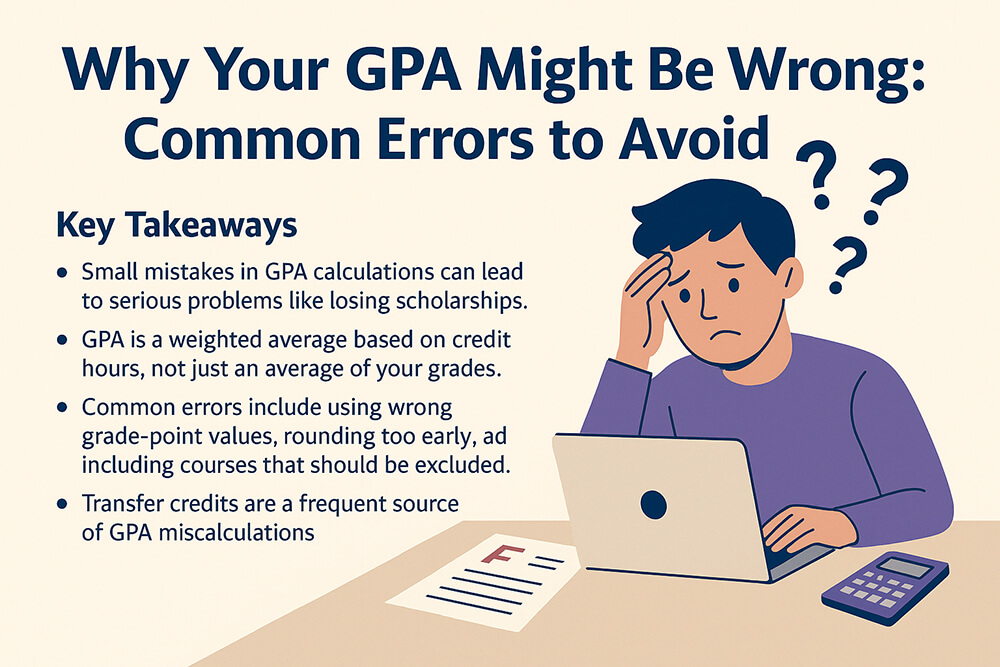
Use this quick checklist:
- You enter the correct letter-to-point scale for your school.
- You match the school’s plus/minus rule (or lack of it).
- You enter the correct credits for each course.
- You count only courses your school includes in unweighted GPA.
Run the numbers in the high school GPA calculator, then track long-term changes in the cumulative GPA calculator. If your result still feels off, compare your method with common GPA calculation errors to avoid.
Frequently Asked Questions
Can I fix a bad freshman year GPA?
Yes. Strong grades later raise your cumulative and show growth, but early grades stay in the average. Use a freshman year GPA predictor to set a realistic target.
Does one B “ruin” an unweighted GPA?
No. One B drops the term GPA, but the impact spreads out over many classes. Run a quick check with a semester GPA calculator.
Do pass/fail classes affect unweighted GPA?
Sometimes. Some schools count P/F as credits only, and some exclude them. Confirm rules in how pass/fail grades impact your GPA.
Should I report weighted or unweighted GPA?
Many schools and colleges look at both, then read the transcript for course rigor. This guide helps: should you report weighted or unweighted GPA.
Why does my GPA not match my transcript average?
Different cutoffs, plus/minus rules, and credit weights can change the final number. Check why GPA does not match transcript.
What is a “good” unweighted GPA?
It depends on your goals, courses, and school context. A strong plan starts with clarity on targets in GPA requirements for college admissions.