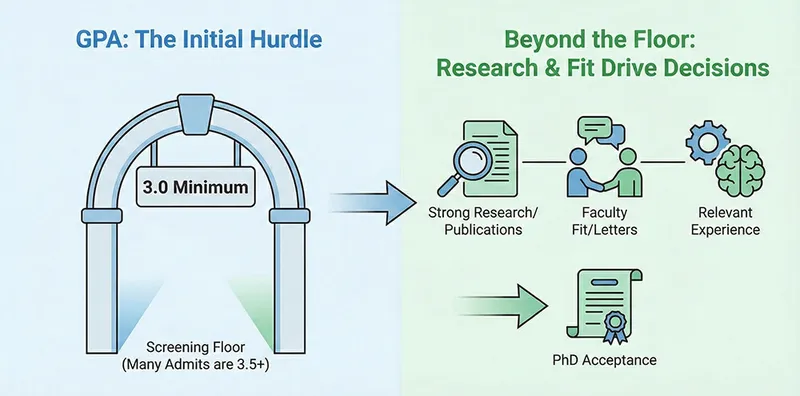
A PhD academic-record audit does not assign schools to GPA tiers. It records what an exact field publishes, how your coursework matches that field, and which research evidence the application requests.
For the difference between a minimum, typical value, and no published minimum, see PhD GPA requirements by field. Use this page to assemble your own evidence.
Define the field and cycle
| Field | Entry |
|---|---|
| University | ____ |
| Graduate field or department | ____ |
| Program | ____ |
| Research area | ____ |
| Entry term | ____ |
| Official application | ____ |
| Checked date | ____ |
Cornell's application steps state that graduate fields set their own requirements and decisions, and direct research applicants to investigate relevant faculty. Do not begin with a university-wide “PhD cutoff.”
Capture the exact GPA language
| Source statement | Classification | Scope |
|---|---|---|
| ____ | Hard minimum / typical / none published / unclear | Program and cycle |
MIT EECS says GPA matters but publishes no official cutoff in its admissions information. MIT Physics also publishes no minimum overall GPA and says physics and related-course grades receive close attention on its graduate admissions page.
Stanford Computer Science currently describes PhD applicants' GPAs as typically at least 3.6 in its FAQ. Record “typically” and the checked date; do not rewrite it as a minimum. Stanford GSB's PhD materials page publishes no minimum, demonstrating variation inside one university.
Audit relevant coursework
| Official preparation area | Course | Level | Credits | Grade | Status |
|---|---|---|---|---|---|
| ____ | ____ | ____ | ____ | ____ | Relevant / pending |
Calculate a relevant-course GPA only when the program requests or defines one. Otherwise label it as a private planning summary.
relevant-course GPA = sum(grade points×credits) ÷ included credits
Do not select favorable courses after seeing the result. Define the inclusion rule first.
Map research evidence to requested materials
| Requested item | Your evidence | Gap |
|---|---|---|
| Statement of purpose or objectives | ____ | ____ |
| Research statement or proposal | ____ | ____ |
| Writing sample or portfolio | ____ | ____ |
| Recommendations | ____ | ____ |
| Faculty or research-area fit | ____ | ____ |
| Prior research output | ____ | ____ |
Only include categories the target program requests or says it evaluates. Research experience cannot be converted into a numeric GPA offset.
Resolve scale and transcript questions
- Report grades on the scale requested by the application.
- Identify every required transcript and translation.
- Do not create a 4.0 conversion unless instructed.
- Keep overall, major, relevant-course, graduate, and application-service GPAs separately labeled.
- Mark unresolved course classifications as pending.
Final audit questions
- Does every numeric claim come from the exact field and cycle?
- Is a typical value clearly separated from a minimum?
- Are relevant courses selected by a stated rule?
- Does each research item correspond to an official application requirement?
- Have program, faculty, test, and transcript instructions been checked on current pages?
- Are unknowns presented as unknown rather than favorable assumptions?
FAQ
Can I convert research experience into GPA points?
No official source cited here supplies such a formula. Present the evidence in the format the program requests.
Does “no cutoff” mean GPA is ignored?
No. MIT EECS says GPA matters, and MIT Physics says relevant course grades receive close attention.
Can two PhD programs at the same university use different language?
Yes. The two Stanford examples use different GPA descriptions, so verify the exact field.