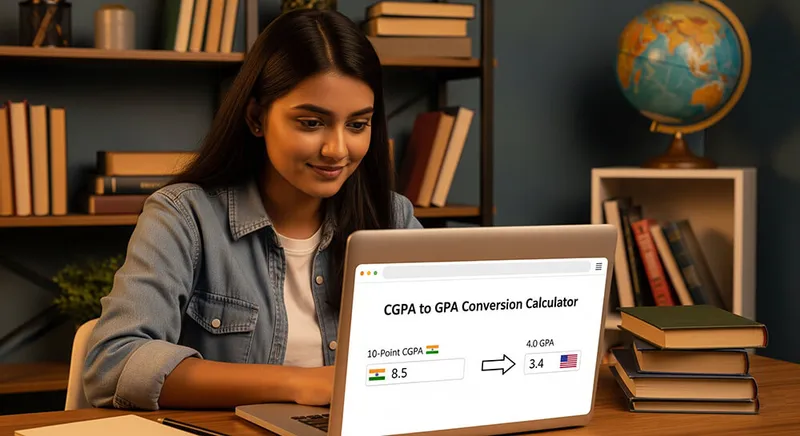
To estimate an Indian 10-point CGPA on the U.S. 4.0 scale, divide by 10 and multiply by 4. An 8.2 CGPA works out to 8.2 ÷ 10 × 4 = 3.28; an 8.5 is 3.40, and a 9.0 is 3.60. This proportional figure is a good first estimate. For applications, U.S. universities usually either accept your CGPA on its original 10-point scale or ask for a credential evaluation, which may give a different number.
Quick CGPA to 4.0 table (proportional)
| CGPA (out of 10) | 4.0-scale estimate | Notional percentage (CGPA × 10) |
|---|---|---|
| 6.0 | 2.40 | 60 |
| 6.5 | 2.60 | 65 |
| 7.0 | 2.80 | 70 |
| 7.5 | 3.00 | 75 |
| 8.0 | 3.20 | 80 |
| 8.2 | 3.28 | 82 |
| 8.5 | 3.40 | 85 |
| 9.0 | 3.60 | 90 |
| 9.5 | 3.80 | 95 |
| 10.0 | 4.00 | 100 |
Working backwards, a U.S. 3.0 sits at 7.5 on this proportional line, and a 3.5 sits at 8.75. You can run any value, either direction, in the CGPA to GPA calculator.
Worked example: what is 8.2 CGPA on a 4.0 scale?
Proportional method
8.2 ÷ 10 = 0.82
0.82 × 4 = 3.28
So 8.2/10 sits at the same relative position as 3.28/4.
Notional percentage method
Many Indian institutions issue a certificate that converts CGPA to a percentage. IIT Madras states that its formula for "conversion of CGPA to percentage (notional)" is CGPA × 10, effective 11 November 2020. IIT Kanpur's certificate says no equivalence of CPI to percentage is provided, but "notionally, the CPI may be multiplied by a factor of 10." For an 8.2, that gives 82.
Some universities use other formulas, so if a form asks for a percentage, request your own university's conversion certificate rather than assuming × 10. A percentage is not a U.S. GPA either; it is just another way of expressing the same Indian grade.
Credential evaluation method
If a U.S. school requires an evaluation from a service such as WES or ECE, the evaluator does not simply rescale 8.2. WES describes its course-by-course report as converting "your semester credits and grades" and then calculating a GPA on a 4.0 scale. Each course's Indian grade is translated into a U.S. grade, then all courses are averaged by credits.
That is why two students with the same 8.2 CGPA can receive different evaluated GPAs: one may have a few low grades balanced by many top grades, the other steady middle grades. Evaluators do not publish one fixed CGPA-to-GPA chart for all Indian universities, so treat any website claiming "WES converts 8.2 to X" with caution. WES's free iGPA tool gives a preview based on common grading scales, and WES states that its tools "do not replace an official evaluation."
Why your evaluated GPA may not match 3.28
Indian 10-point systems differ between universities. A typical relative grading scheme awards 10 for the top grade, 9 for the next, and so on down to a pass grade, with a fail at 0. The pass grade, how many students receive top grades, and how many credits each course carries all vary. A U.S. scale is also capped: every A counts 4.0, no matter how far above the cutoff it is.
Here is a fictional four-course term to show the difference:
| Course | Credits | Grade points (out of 10) | Points × credits |
|---|---|---|---|
| Data Structures | 4 | 10 | 40 |
| Signals | 4 | 8 | 32 |
| Mathematics III | 3 | 7 | 21 |
| Lab | 2 | 9 | 18 |
| Total | 13 | 111 |
CGPA = 111 ÷ 13 = 8.54
Proportional estimate = 8.54 ÷ 10 × 4 = 3.42
An evaluator would instead map each course grade (10, 8, 7, 9) to a U.S. letter grade using its own country scale, then compute a credit-weighted GPA. If its scale treated both 10 and 9 as A (4.0), for example, the result would differ from 3.42. The direction depends entirely on the evaluator's scale, which is why only the official report should be quoted as your evaluated GPA.
Which number to put on an application
Your target school's instructions decide. The usual cases:
- The form asks for GPA and scale. Enter your CGPA exactly as printed, with "out of 10." The University of Maryland Graduate School, for example, says you may submit your GPA using your own institution's grading scale.
- The form asks for a 4.0 GPA and gives no method. Give the proportional value only if you can label it, and keep your original CGPA alongside it. When in doubt, email admissions.
- The school requires WES, ECE or another named evaluator. Order the report type it asks for (usually course-by-course) and use the GPA on that report.
The international GPA conversion guide covers when an evaluation is worth ordering.
Common mistakes
- Multiplying by 9.5 for a university CGPA. That factor is associated with some school-board results, not university degrees. Use your university's certificate.
- Treating the proportional figure as official. It is a quick estimate, nothing more.
- Mixing semester SGPA with CGPA. Convert the cumulative value unless the form asks for a specific term. The semester-to-cumulative guide explains the difference.
- Ordering the wrong report. A document-by-document evaluation usually does not include a GPA.
- Rounding up. Keep two decimals: 8.24 should stay 8.24, not 8.3.
Frequently asked questions
What is 8.2 CGPA on a 4.0 scale?
Proportionally, 3.28. As a notional percentage under the × 10 rule used by IIT Madras and IIT Kanpur, it is 82. An evaluated GPA from WES or ECE can differ because it is calculated course by course.
What CGPA equals a 3.0 GPA?
On the proportional line, 7.5 out of 10. Evaluated GPAs do not follow a fixed line, so treat 7.5 as a rough guide.
Is 3.4 a good U.S. GPA equivalent?
It depends on the program. Check the program's own minimum and whether it states its requirement for Indian degrees.
Do I need WES for U.S. graduate school?
Only if the program requires it. Many U.S. programs review Indian transcripts themselves and accept the 10-point CGPA.
Is CGPA × 10 the same at every university?
No. IIT Madras and IIT Kanpur publish × 10 as a notional conversion, but other universities may use different formulas. Ask your registrar for your own certificate.