The short answer
Year and policy note: The Princeton example is a 2024–2025 school profile; the other examples reflect the official pages checked on September 16, 2026. Recheck the issuing authority's current policy before using any rule.
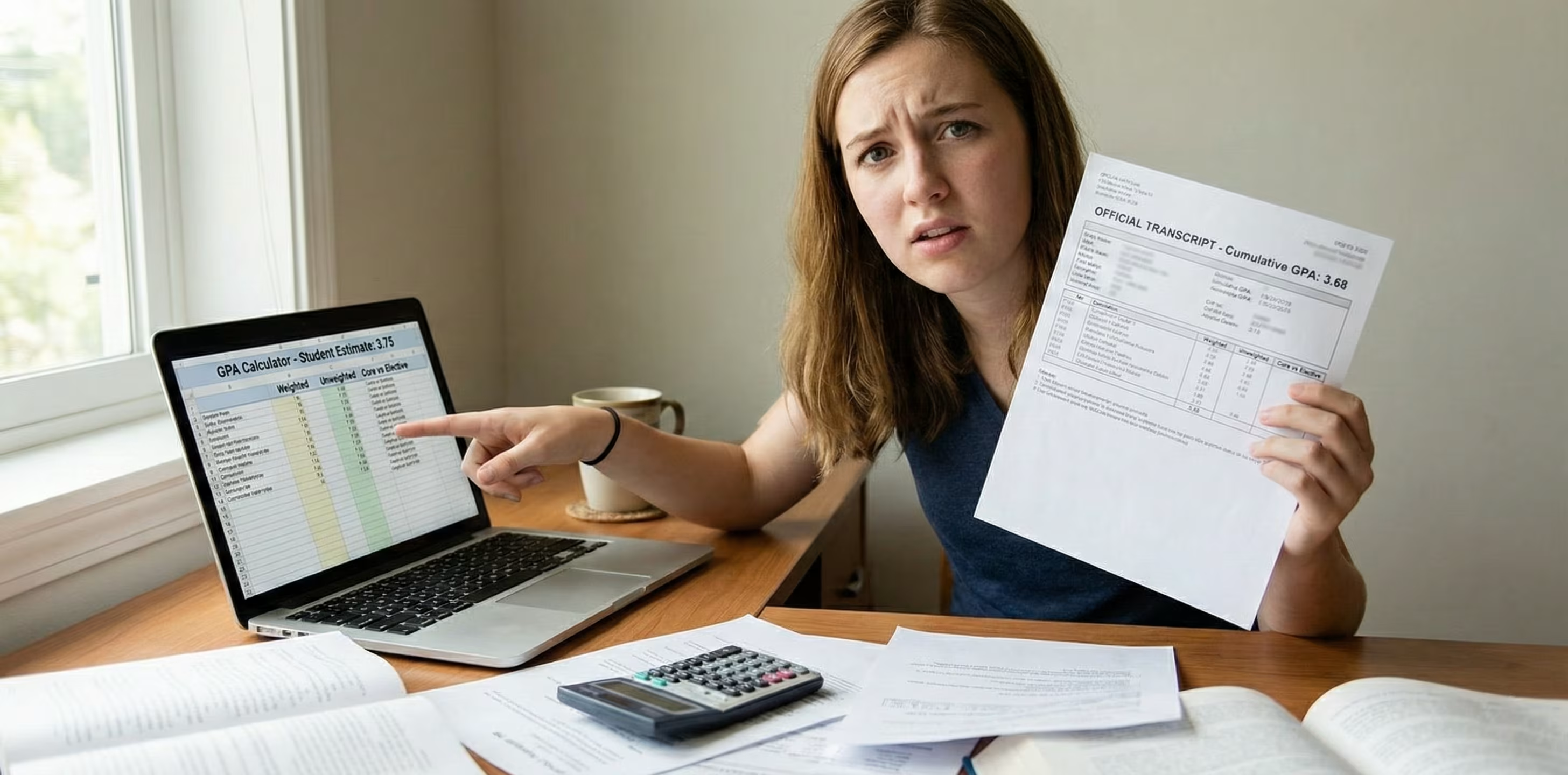
“4.0,” “5.0,” and “6.0” are reporting labels, not standardized national algorithms. You cannot determine a GPA's weighting, true ceiling, course treatment, or meaning from the label alone.
Common App's current high-school worksheet makes this visible: it records the GPA scale and weighted/unweighted status in separate fields. It accepts many scale values and also allows no GPA scale.
Three official examples that do not fit one conversion chart
Fairfax County Public Schools
FCPS publishes a 4.0 base grade-point table and adds 0.5 points to designated Honors courses and 1.0 to designated AP, Advanced, Dual Enrollment, and IB courses. A system with a 4.0 base can therefore produce weighted course values above 4.0.
Princeton Independent School District
Princeton High School's 2024–2025 profile labels course categories Regular 5.0, Honors 5.5, and Dual Credit/AP 6.0. The same profile separately defines which records enter its weighted GPA and class rank.
Cypress-Fairbanks Independent School District
CFISD describes its policy as a weighted 6.0 grading scale, yet its published table assigns 7 points for an A in K/AP/HORIZONS courses, 6 for an A in an on-level category, and other values for other categories.
That is not an error to “fix.” It demonstrates that a nominal label is not necessarily the highest course-grade value.
What the scale number does not tell you
| Missing field | Why it matters |
|---|---|
| Weighted or unweighted status | A 4.0-labeled/base record may still add course weight |
| Grade-point table | Plus/minus and letter values can differ |
| Course categories | Honors, AP, IB, and dual enrollment are not automatically treated alike |
| Included records | Grade levels, repeats, pass/fail, and middle-school credit may differ |
| Denominator | A policy may use courses, credits, or another unit |
| Caps | A bonus may be limited by course count, semester, grade, or year |
| Rank rule | A school may use a different calculation for rank or may not rank |
| Effective date | Policies can change between cohorts |
Why direct conversion fails
Dividing a 5.6 GPA by 6 and multiplying by 4 produces a ratio, not an official 4.0 GPA. It assumes both scales have the same course population and linear spacing. The official examples above show why those assumptions can fail.
For a real record:
- Preserve the reported GPA.
- Preserve the reported scale and weighting label.
- Keep the school profile or transcript legend.
- Do not replace course categories with another school's categories.
- Follow the receiving institution's current instructions.
If a form requests a different scale but gives no method, ask the recipient how to complete the field. Do not present a self-created rescaling as official.
A safe hypothetical comparison
You can compare formulas for learning if every assumption is explicit. Suppose a student has four equal-credit grades: A, A, B, and B.
Under a no-bonus example where A=4 and B=3, the result is (4 + 4 + 3 + 3) ÷ 4 = 3.50.
If a separate hypothetical rule adds 1 point to one eligible A and 0.5 to one eligible B, the result is (5 + 4 + 3.5 + 3) ÷ 4 = 3.875.
Neither result is the student's official GPA until the assumed table, course eligibility, denominator, and rounding match the issuing policy.
A practical scale audit
Use this checklist before using a GPA calculator:
- Who calculates the number?
- What year or cohort does the rule cover?
- Is the reported GPA weighted?
- Which grade table is used?
- Which course codes receive weight?
- What records are included or excluded?
- Are bonuses capped?
- How is the result rounded?
For a deeper policy-entry worksheet, see the 5.0 GPA scale guide. If the calculation does not match the school record, use why GPA does not match your transcript.
FAQ
Does 4.0 always mean unweighted?
No. FCPS is a current counterexample: it publishes a 4.0 base table and adds designated course weights.
Is 5.0 the standard weighted scale?
There is no official national standard established by that label. Use the school or district's exact policy.
Is 6.0 always the maximum in a 6.0 system?
No. CFISD calls its system a weighted 6.0 scale while publishing a 7-point value for one category-grade combination.
Is unweighted GPA always better for comparing schools?
No. Two unweighted calculations can still use different course populations, grade tables, credits, repeats, and rounding.
What should I report on an application?
Follow the current prompt. Preserve the number, scale, and weighting status exactly as requested rather than inventing a cross-scale equivalent.